
Misted and failed rooflights replaced across Liverpool
Misted or failed rooflight and skylight units replaced in Liverpool: new sealed glass or a new unit, chosen after a survey of the frame and kerb.
- Like-for-like or a new size
- Old unit taken out and away
- Building Control handled
- 10-year workmanship guarantee
Misted rooflight replacement, start to finish
Everything that decides a good replacement
Chapter 01
When the glass clouds over from the inside
How to tell a failed sealed unit from a dirty or steamed-up one, and why a misted pane still works as a roof covering.
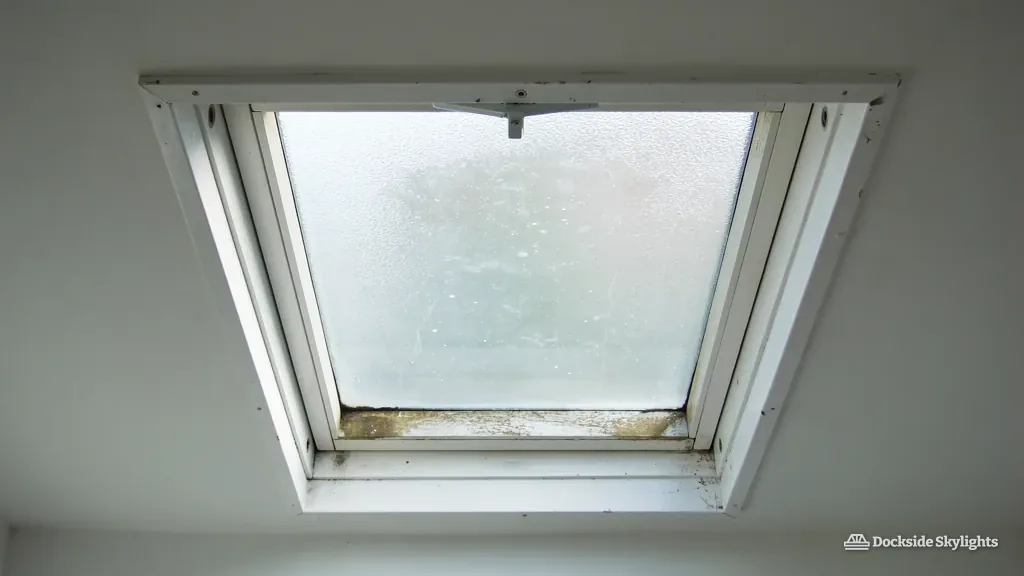
Misted rooflight replacement starts with a simple observation: the cloud is on the wrong side of the glass. You look up at the flat rooflight over the kitchen, or at the roof window on the landing, and a grey haze hangs in it. Some days it thins a little. Other days it returns as beads of water or a pale film, and no amount of cleaning outside or in makes any difference. That haze lives in the space between the two sheets of glass, and it is the clearest sign that the sealed unit has failed.
A sealed unit is two sheets of glass held a small distance apart by a spacer bar, with sealant running round the edge. The spacer holds a drying agent that soaks up the small amount of moisture trapped when the unit was made, and in many units the gap is filled with a gas that slows heat loss. While the edge seal holds, the gap stays dry and clear. Once the seal opens, damp air gets in, the drying agent fills up, and the first time the glass chills the moisture condenses where nobody can wipe it away.
Fogged inside the unit
- Haze, droplets or a whitish film that no cloth reaches
- Shows from inside and from outside, whichever side you look from
- Worst after a cold night, and may fade a little when the glass warms
- Means the edge seal has opened, so the unit needs replacing
Dirty, or condensing on a surface
- Smears, moss, algae or grime that wipes off
- Droplets on the room side in a steamy kitchen or bathroom, which dry off
- Clears when the room is ventilated or the surface is washed
- Needs cleaning or better ventilation, not a new unit
Homeowners across Merseyside tend to describe this as failed skylight glass in Liverpool terms, a phrase that covers every unit from a Victorian back-bedroom roof window to the lantern on a new kitchen extension. Tradespeople say a blown or failed sealed unit, and it is the same fault. The glass itself is usually still sound and still keeping the rain out. What has gone is its insulation, its clear view and its looks. That matters most in a room you use every day, such as a rear kitchen where the rooflight is the main source of daylight, or a landing where a clouded roof window turns a bright stairwell into a dim one.
It also matters for comfort. A unit with a broken seal lets damp air into the cavity, and any gas fill that helped it insulate can escape, so the room under it can feel colder on a frosty night and the inner pane runs with condensation more often than it did.
Before anyone orders anything, it helps to be sure what you are looking at. Cloudy glass has several causes, and only one of them means a new unit.
Chapter 02
Why edge seals fail in a roof: swings of frost and sun, standing water on the kerb, hot dark frames and poor original fitting.
What makes a sealed unit give up
Every double-glazed unit relies on its edge seal for the whole of its life, and a roof is a tougher home for one than a wall. The glass faces the sky, so it takes the full swing of the weather: frost on a clear night, strong sun on a July day, then a cold downpour on the same glass. Each swing makes the panes and the spacer expand and shrink by tiny amounts, and over the years the sealant is asked to stretch with them. Eventually it pulls away from the glass at one corner, and that corner is where moisture starts to creep in.
Standing water makes it worse. A flat rooflight sits on a kerb, and if the roof around it does not drain well, water can lie against the frame for days after rain. Sealants are not designed to live underwater. A rooflight with moss at its upstand or a puddle against one side often shows misting on that side first, and the haze then spreads across the unit.
Sun is the other pressure, especially on units glazed into the bars of a lantern. Dark frames soak up heat and pass it to the edge of the glass, which is hot in the afternoon and cold again overnight. Sealants harden with that treatment and lose their grip. Roof windows meet the same stresses, although the frame often shades the edge of the inner pane a little.
Poor original fitting is a smaller cause but a real one. A unit squeezed into a frame too tightly, or sitting on the wrong packers, is under strain from day one. Drainage channels blocked with paint or debris have the same effect as a puddle on the kerb, because water sits in the glazing rebate and works on the sealant from outside.
We cover the mechanics in full in the guide to why rooflight glass mists between the panes, including where the weak points are on different types of frame. The short version for this page is that nothing you did made it happen, and that waiting does not make the unit recover, because a failed seal does not mend itself.
A misted rooflight still works as a roof, but it no longer works as a window.
That distinction takes the panic out of the decision. A clouded unit rarely leaks, so you have time to arrange a survey, compare the options and choose a sensible date. What you should not do is leave it for years, because the condition that let moisture in at the edge of the glass can also be letting it into the frame.
Chapter 03
How long units last and what to look for
Age, the signs to look for in the glass and the sealant, and why the frame needs checking as closely as the unit.
The natural question is how old a unit can get before it is due to fail. There is no single honest answer, because the life of a sealed unit depends on how well it was made, how much sun and standing water it sees and how well it was fitted. A good unit in a well-drained frame will outlast a cheap one on a roof that holds puddles. Our guide to how long rooflight sealed units last goes through the factors one at a time.
What we can say is that the first warning is almost never total. A unit starts by misting in one corner after a cold night, and the haze spreads over a season or two. Beads of water between the panes appear after rain. A faint line shows along the edge of the glass where the sealant has pulled back. If you can see the edge of the unit from inside, look at it with a torch: a dull, cracked or shrunken strip of sealant is a useful clue.
- Check whether the haze sits on one pane or between two, by touching the room side of the glass
- Note any staining, rust or lifting paint around the inside of the frame
- Look for water marks on the ceiling or reveals beside the rooflight
- Check the kerb outside, if you can see it safely from a window, for standing water or moss
- Photograph the whole unit, inside and out, to send us before the survey
Age shows more clearly in the surroundings. A rooflight installed a couple of decades ago may have an aluminium or timber frame that is still sound, with the glass the only part that has worn out. Older units also tend to have a thinner glazing build and less insulation than a modern one, so a new unit often makes the room feel warmer before anyone has measured a thing.
The frame is what we look at hardest. A failed unit in a frame that is itself rotten, corroded or leaking is the wrong job to treat in isolation, and we tell you so at the survey. If the frame is the real trouble, it is better to learn that before a new unit is ordered than after it is delivered.
Sunlight matters for the pattern too. On a south-facing flat roof the unit that mists first is usually the one that gets the most direct sun, while on a shaded roof under a tree, the damp and the leaf litter are the likelier culprits. Knowing which applies tells us whether a new unit alone will last, or whether the surroundings need attention as well.
Never climb onto a roof to take pictures. A phone photo from a window or from the room is enough. If you send it on WhatsApp, we can usually say whether the unit looks like a glass-only job or a whole-unit job before we have set foot on the roof. The survey then confirms it, and the price comes only after we have measured and looked properly.
Chapter 04
Flat glass on a kerb, plastic domes, roof lanterns and pitched roof windows, and the route to replacement for each.
Flat glass, domes, lanterns and roof windows
A word about the people who have this problem. It tends to turn up in the same few places: the flat rooflight over a kitchen extension added to a terrace or a 1930s semi, the lantern on a larger extension, and the roof window that lights a loft room or landing. Each of those has its own pattern, so it is worth knowing which one you have.
The right answer depends on what is on your roof, so we start by naming it. Failed units in Liverpool houses fall into four families, and the choice of route follows from the family.
Flat glass rooflights on a kerb. These are the rectangular units on kitchen extensions, porches and garage conversions, with a flat or very slightly domed glass top on a raised frame. The sealed glass unit sits in a rebate in the frame, held by a bead or a cap. If the frame is still square and sound, the unit can sometimes be lifted out and replaced with a made-to-measure new one. If the frame has corroded or the kerb has failed, the whole rooflight comes off. Our flat roof rooflights page describes the products that go in.
Plastic domes. The domed rooflights that went onto thousands of flat roofs in earlier decades were usually acrylic or polycarbonate, often two skins with an air gap. These do not mist like glass. They yellow, craze or collect dirt between the skins. A sealed glass unit cannot go into a plastic dome frame, so the dome comes off and the choice is a new dome or a glass rooflight on a new kerb. For most kitchens we steer people towards glass, which stays clear and insulates better.
Roof lanterns. A lantern is a glazed roof structure, with bars rising on each face to a ridge, and the glass sits between the bars in separate panes. Because the panes are separate, one misted pane can sometimes be replaced without disturbing the rest, provided the bars and cappings are sound and the new unit can be glazed neatly. The guide to replacing just the glass in a roof lantern explains when that works and when it does not. For a new lantern altogether, see roof lantern installation.
Pitched roof windows. A roof window in a slate or tile slope is a framed sash with the glass held in it. On most makes the sealed unit is not a loose part: the sash and the glass are made as one, so the usual route is a replacement sash where the maker still supplies one, or a new window with its own flashing. If you have a VELUX or equivalent window with misted glass, our VELUX window installation page covers what goes in its place.


Whatever the family, the first look is always at the same thing, which is the surrounding structure. The kerb, the flashing and the covering that surrounds the glass are what keep the house dry for the next ten years, and they are where a careful eye earns its keep.
Chapter 05
New glass in the old frame, or a new rooflight
When new sealed glass can go into the existing frame and when the whole rooflight has to be replaced.
This is the choice that matters most to your budget, and the one that most often goes wrong when it is made over the phone. Replacing only the sealed glass is quicker and costs less than replacing the whole rooflight. It is also only right if everything around the glass is in good order. Putting a new unit into a tired frame is a poor bargain: the frame will still rot or leak, and you will pay again to take the same roof apart.
On site, we work through the questions in a set order so nothing is skipped. Our guide to new glass or a new rooflight shows how the reasoning runs, and the survey follows it step by step.
- Look at the frame. We check for corrosion, rot, loose joints and damage to the finish. Timber and aluminium both show their age at the corners first.
- Check the kerb and the covering. A kerb that holds water, a felt or single-ply upstand that has split, or flashing that has lifted will let water in whatever glass is fitted. These show whether the roof needs work beyond the glass.
- Measure the rebate and the failed unit. The thickness of the existing glass, the depth of the rebate and the type of bead all limit what can go back in. Modern units have a different build-up from older ones, and not every old frame can take a thicker modern unit.
- Test against the thermal target. A replacement has to meet the limits covered in the next chapter, so we confirm that new glass in the old frame can still reach them.
- Write down the recommendation. We tell you which route we would take and why, and attach a firm written price to it. If both routes are sensible, you see both.
Cost is an obvious part of the decision, and we deal with it frankly once there is a survey in front of us. Until then, you can read what moves the figure up or down in the guide to what a misted unit costs to replace, and see how we price work generally on the costs page. You will not get a number from us before we have looked at the roof, because the figure depends on the frame, the kerb or flashing and the size of the opening, which only a survey shows.
One more point favours the whole-unit route. If the rooflight is old enough that its frame is thin, single-skinned or poorly insulated, a new complete unit with a thermally broken frame performs very differently from new glass in the old one. The glass is only one element of the unit, which is why we set out what each route delivers alongside what it costs.
Chapter 06
The thermal limits a replacement has to reach, the Building Control notification and the planning position when the new unit matches the old one.
The rules a replacement has to meet
Rooflights, lanterns and flat glass
- Existing dwellings: 2.2 W/m²K
- Roof lanterns are counted here
- Sit on a kerb or upstand
- The replacement has to reach the limit
Roof windows in a pitched slope
- Existing dwellings: 1.4 W/m²K or WER band B
- Sit in the plane of the roof
- Flashing matched to the covering
- The replacement has to reach the limit
Under the Building Regulations 2010, England treats a new or replacement rooflight as controlled work. You will not need to contact the council or a private inspector yourself, because the Building Control notice is ours to send whenever the job needs one; the notice can go to the local authority or to a registered building control approver, a title private inspectors have carried only since April 2024. At the end, a completion certificate comes from the council or a final certificate from the approver, and we pass it on to you.
Whether a particular job is notifiable depends on what is being replaced. A new rooflight or roof window going into the opening is clearly work to tell building control about. New sealed glass going into an existing frame is a finer question, and we settle it at the survey, because the answer turns on what is being changed. We would rather ask before the work than after it.
The thermal side is straightforward. Existing dwellings are held to 2.2 W/m²K for rooflights by the 2021 edition of Approved Document L volume 1, in its Table 4.2, while roof windows need Window Energy Rating band B or a U-value of 1.4 W/m²K. Roof lanterns count as rooflights. England moves to the 2026 edition on 24 March 2027; the existing-dwelling figures stay as they are and the table becomes Table 3.2. An old unit from decades ago will probably fall short of these figures, and a new one is chosen to meet them, which is part of why a replacement makes a room feel better to sit in.
Planning is rarely an issue when the new unit matches the old. Under Class C in Part 1 of Schedule 2 of the 2015 General Permitted Development Order, a rooflight in England is normally covered, as long as the limits that apply are respected. A replacement with matching dimensions, at the same height, does not change the roof in a way that raises fresh questions. The exceptions are flats and maisonettes, which do not have those rights, listed buildings, which need listed building consent, and properties under an Article 4 direction. Our guide to planning permission for a skylight goes through the conditions properly, so we do not restate them here.
If your rooflight sits on an older slate slope in a sensitive setting and the unit has failed, you may want to look at the slimmer styles covered on our conservation rooflights page, which sit low in the slope and suit older roofs better than a standard box.
Across Flintshire and Wrexham the same job runs under the Welsh version of the rules, and our surveyor will tell you which applies to your address when we book the visit.
Chapter 07
What the replacement looks like on site
How a typical job runs, from the survey measurements and the protected room to the mid-job look at the frame.
Most misted unit jobs are quicker than people expect, because the work is concentrated on one opening. A glass-only replacement on a flat rooflight is usually a short visit once the new unit has been made. A whole rooflight takes longer, since the old frame is lifted, the kerb is checked and the new frame is bedded and flashed. A pitched roof window falls somewhere between the two. We confirm the likely length at the survey so you can plan around it.
Weather is the other thing we watch. Rooflight work leaves an opening in the roof for a short time, so we plan around the forecast, and on the Wirral coast and the exposed estates further inland we are careful about wind when a large pane is being handled. Should the weather turn, the opening is made safe and watertight before we stop, and we rebook rather than push on.
Measure and order
The survey gives exact sizes. The new unit or frame is made to those sizes, because rooflights are rarely off the shelf. The written quote is agreed with you first, and only then does an order go in.
Protect and open up
We cover the room below, check the weather and the roof, and set up safe access. The old beads, caps or fixings come off and the failed unit is lifted away.
Look at what was underneath
With the old unit out, we see the frame, rebate, kerb and flashing properly for the first time. If anything needs attention it is dealt with now, and we talk to you before changing the plan.
New unit in and sealed
The new unit goes in on fresh setting blocks, is bedded and secured, then sealed so that water runs off and away. Where the kerb or flashing needs it, that is dressed to suit.
Clean and hand over
The glass is cleaned on both sides, the room is cleared and the failed unit goes with us. You get a walk-round, the paperwork and the guarantee.
We work in lived-in houses, and that shapes how we set up. Floors under the opening are covered, furniture is moved clear and dust sheets go up before anything is lifted. If the job needs access from inside, such as lowering a glass unit through a ceiling opening, we plan the route first, because a pane that size is heavy and awkward on a landing stair.
The mid-job look is the single point at which a glass-only job might turn into something larger, which is why we leave a little room in the plan for the unexpected. A rotten bead or a hidden stain usually means a few extra pieces of work, not a rethink of the whole job, and you hear about it as it happens rather than at the end.
Old units are heavy, and the glass is not something to leave on a lawn. We take away what we remove and dispose of it properly, so nothing is left behind in the garden or the skip you were not expecting to hire.

Chapter 08
Photos on WhatsApp, a survey, a written price that does not change and the 10-year written guarantee on the workmanship.
How to get a misted unit looked at
Send us a few photos on WhatsApp, or phone, and tell us roughly where the rooflight is and what you can see in it. We will say what looks likely, book a survey and come to measure. The survey is where we get onto the roof, look at the frame, check the kerb or flashing and confirm the size of the opening. No price is given before that, and none changes afterwards unless you ask us to do something extra.
Once we have surveyed, a fixed quote follows in writing. It names the work, the unit and what happens to the old one, so nothing is left to surprise you later. If a glass-only job and a whole-unit job are both worth considering, the quote shows both side by side, with our recommendation.
When the work is done, the workmanship guarantee runs for 10 years and is given in writing. Our guarantee page explains what it covers. If the job is notifiable we make the Building Control notification ourselves, so there is no certificate for you to chase from the council.
We cover houses of every age around Liverpool, from slate terraces with an old rear rooflight to 1930s semis with a kitchen extension on the back, and our house types guide shows how rooflights sit on each. If misting has made you think about the rest of your roof glass, two other pages may help. Energy efficient rooflights looks at what a better-performing unit can do for a room, and roof window installation covers the pitched side.
Cloudy glass between the panes is a fault in the sealed unit, and the survey establishes what is in the frame before anything is chosen to go into it.
It also helps to tell us how the room is used. A rear kitchen with a lantern over the dining end, a landing roof window that lights a staircase and a utility room with a small flat rooflight all call for slightly different thinking, from the glass specification to how the new unit is opened or ventilated. Tell us what bothers you most, whether that is glare, a cold room or simply the look of the cloud, and the quote can be built around it.
Photos sent our way are all it takes to start. Get a free quote
Free survey
Get a fixed quote for your replacement rooflight
- No obligation
- We survey the roof before we price
- WhatsApp or phone, whichever suits
What happens next: we arrange a survey at a time that suits you, measure the roof and the room, then send a fixed written quote. Nothing is booked until you say yes.