Short answer: Yes, in most cases. Listed building consent for a rooflight is needed whenever the work affects the character of a listed building, and a new unit, or a replacement that differs from the one it replaces, usually does. Consent is separate from planning permission and from Building Regulations, so a listed house needs to be checked before anyone orders a unit.
What listing changes
Listed building consent is a different permission from planning permission. It exists to protect the special interest of a building, and it applies to the whole of a listed building, inside and out, whatever the grade. A roof is part of that. So the question of listed building consent for a rooflight comes down to one test: will the work affect the character of the building as one of special architectural or historic interest?
A skylight on a listed building almost always meets that test. Cutting an opening through historic rafters, lifting original slates and putting glass in a slope that was solid are all changes to the fabric. Even a rooflight on the back slope, out of sight from the street, alters old timber and old covering. Working without consent where it is needed is a criminal offence, and anyone who carries out the work or has it done can be liable, the owner as well as the builder.
The permitted development rights that let owners fit rooflights to ordinary houses do not carry over. If your home is listed, you start from the opposite position, and you ask the council first.
Which council handles the application, in England and in Wales
In England the local planning authority decides, with advice from its conservation officer. Liverpool addresses go to the city council. Elsewhere, whether in the Wirral, Sefton, Knowsley, St Helens or another borough, the council covering the address is the one to ask. Historic England publishes the guidance that officers and owners both rely on, and it has a say on the most highly graded buildings. Its pages are at historicengland.org.uk, and the national list can be searched there to confirm whether a house is listed and at what grade.
In Wales the application also goes to the local planning authority. For Flintshire and Wrexham, that is the county council or county borough council. The national heritage body there is Cadw, which keeps the Welsh register of listed buildings and publishes the guidance. Its site is cadw.gov.wales. The law differs a little between the two nations, so a Welsh address is dealt with through Cadw's route, not English guidance.
Many people are surprised by how much Liverpool has to look after. Central Liverpool has many listed Georgian townhouses and Victorian merchant houses, and Port Sunlight on the Wirral has listed buildings of its own. Grade matters less for this question than it first seems: consent is needed at every grade.
Replacing an existing rooflight on a listed roof
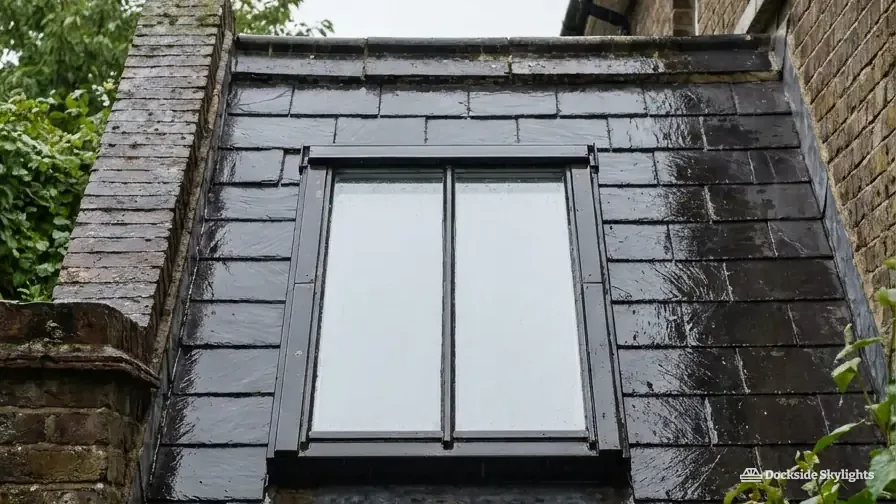
A like-for-like swap is the case that causes most confusion. Owners reasonably think that replacing a worn rooflight with an identical one is maintenance. Sometimes that holds, but only when the replacement matches the original in size, materials, profile and the way it is fixed. A new unit that is thicker, shinier, taller above the slates or differently barred counts as a change.
The age of the existing unit matters as well. A modern white-framed window fitted in the 1990s may itself have gone in without consent, and the council can decide whether a replacement should be a better match for the roof than what is there now. A well-made conservation rooflight often helps, because it sits flush and reads as part of the slope. Our guide to conservation rooflight design explains what makes a unit look right on an old roof.
If you are unsure whether a swap needs consent, ask the council's conservation officer in writing before ordering. The reply is the safest evidence you can hold.
Getting consent in practice
An application usually needs a drawing of the roof and the position of each rooflight, the make and model with its dimensions, a section showing how it sits in the slates, and a short statement of why the work is needed and how it respects the building. Officers read the application for the harm done to the building and for what is gained. Fewer and smaller units, placed on the rear slope, with a flush profile, go through more easily than a row of large ones on the front.
The council has a set period to reach a decision on an application, and it may ask for changes first. Plan on a gap between the survey and the start date, and do not book roof work until the decision notice is in your hand. The decision may include conditions, such as a named product or a finish, and those become part of the job.
Consent for a listed building does not replace the other approvals. Separate from consent, the Building Regulations in England still cover the work, and for notifiable jobs we take that notification to Building Control on your behalf. Planning questions for unlisted streets are of a different kind; rooflights in a conservation area deals with them, Article 4 directions included. For an overall view of permission for a skylight, see planning permission for a skylight.
- Confirm the listing and grade on the national list
- Ask the conservation officer about the exact unit and slope
- Have the survey and drawings ready for the application
- Wait for the decision notice before ordering
- Read any conditions before the fitting date
Where we come in
We survey the roof first and tell you what will suit it, then provide the dimensions and section drawings that an application needs. Pricing waits until the council has reached its decision: the written quote is then fixed for the approved unit, and the workmanship is guaranteed for ten years in writing. Photographs of the roof on WhatsApp, with a line about the listing, are the easiest way in; a free quote request works too. The conservation rooflight installation page has the full range of work.
Quick points on listed roofs
Is a rooflight at the back of a listed house exempt?
No. Consent depends on whether the work affects the character of the building, not on whether the street can see it. Cutting through old rafters and slates changes the fabric wherever the slope faces.
Does a house in a conservation area need listed building consent?
Only if the house is itself listed. A conservation area on its own raises different questions, covered in our guide on conservation area rooflights.
What happens if the work was done without consent?
The council can require the building to be put back as it was, and the owner may face prosecution. Buyers' solicitors also ask about it, so it can hold up a sale.