Two frames, one decision that lasts
The aluminium vs upvc roof lantern question comes up at many lantern surveys, often from homeowners who have seen both and liked each for a different reason. It deserves a proper answer, because the frame is the one part of a roof lantern you cannot change later.
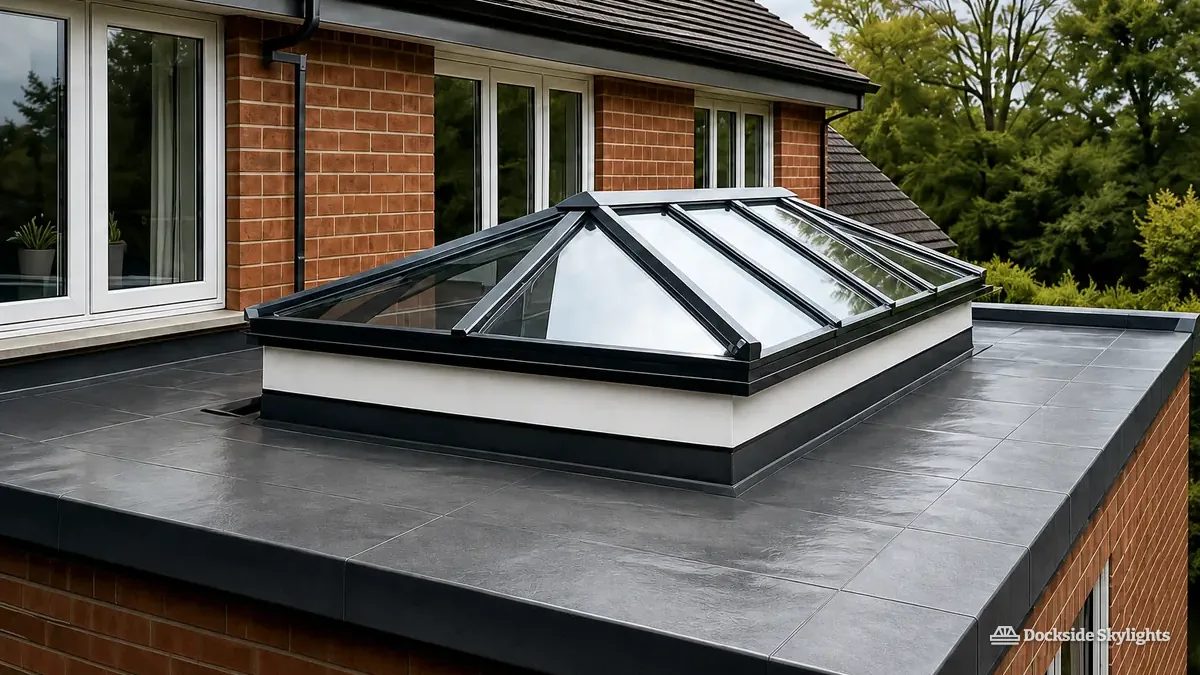
Builders call it a rooflight and homeowners call it a skylight, yet either way a roof lantern is a small glazed roof: a frame holding a set of glass panels. The frame does three jobs. It carries the glass and the load on it, it keeps rain out at every joint, and it sets how the lantern looks from the kitchen and from the garden. Aluminium and uPVC do those jobs differently, and the best roof lantern material for your extension depends on which of the three matters most to you.
This guide compares the two frames on what you will notice: how thick the bars look, how the ridge is shaped, what colours are on offer, how each copes with the wind and rain that arrive off the Irish Sea, and what glass can go into either. Sizing is covered in the roof lantern sizes guide, and the fitting itself is on the roof lantern installation page.
An aluminium lantern frame is built from extruded aluminium sections, cut to length and joined at the corners and along the ridge. Good ones are thermally broken, which means the inner and outer faces of each bar are separated by a strip of low-conductivity plastic. Without that strip, a bar of metal would carry cold straight through the frame and show it as condensation on a winter morning. With it, the inside face of the bar stays much closer to room temperature.
A uPVC lantern frame is built from hollow plastic profiles, welded or mechanically joined, with chambers inside that trap air and add some insulation of their own. Plastic on its own is not stiff enough to span a roof, so uPVC lantern profiles are normally reinforced with steel or aluminium inside the bars. You do not see the reinforcement, but it does the structural work, and it is the reason a uPVC bar is deeper and wider than an aluminium one for the same span.
That one difference, how stiff the material is for its thickness, drives most of what follows. Aluminium is strong enough to be drawn into slim sections. uPVC needs bulk to reach the same strength, so its bars look heavier.
Bar thickness and sightlines
Stand inside a kitchen extension and look up. What you see of the lantern is the glass and the bars between the panels. Those bars are the sightlines. Slim bars let the sky read as a single pane of light, with the frame fading into the background. Thick bars read as a grid laid across the sky, and they cast a heavier shadow pattern on the floor when the sun is out.
Aluminium wins on sightlines. Its bars can be narrow on the inside face, and the glass sits close to the frame, so the lantern looks more like glass and less like a structure. That is why aluminium is the usual choice for contemporary extensions with bifold doors, where the aim is for the whole back of the house to feel open. The narrow bars matter even more on larger lanterns, because a wide span with chunky bars takes over a room.
uPVC bars are wider across the face and deeper through the section. On a small lantern over a narrow kitchen or a hallway, that is not a problem, and many people like the solid look of a white frame against a white ceiling. On a lantern more than a metre or so across, the frame starts to dominate, and the gap between the glass panels becomes a feature you notice rather than a line you ignore.
The frame is what you see every day. The glass is what you see through.
Ridge design and the shape of the roof
A lantern is more than a frame, because it has a shape. The usual forms are a hipped lantern with a ridge and sloping ends, a gable-ended lantern with vertical end panels, and a pyramid with four faces rising to a point. Each has a ridge or an apex, and how that detail is finished changes the character of the whole lantern.
Aluminium lanterns usually have a clean, square-edged ridge, sometimes with a slim capping and nothing more. That suits a modern extension and sits well on a rendered or brick box with a crisp parapet. Many makers also offer a decorative ridge cresting and finials, for houses where the lantern should look like part of the Victorian original. On a villa in Oxton or Birkdale, a traditional-looking lantern with cresting sits more comfortably than a plain contemporary one.
uPVC lanterns often come with a more traditional ridge detail, with moulded end caps and covers. The result is often a more pronounced, rounded ridge and a chunky look from the outside. That can be a good match for a conservatory-style extension, or for a house with other white-framed uPVC windows, where a slim aluminium lantern might look out of place.
Colours and finishes
Aluminium frames are powder-coated, a baked-on finish applied in a factory, and the range of colours is wide. Anthracite grey is the favourite for new extensions because it matches the grey aluminium bifold doors and window frames that go with them. Black, white, a range of greys and several greens and blues are standard, and most makers will match a colour from the RAL range on request. Many offer a dual-colour option: grey on the outside to match the roof and window frames, white on the inside to blend with the ceiling.
uPVC is most often white, and it is also sold in woodgrain foils such as golden oak and rosewood, plus a few greys, applied over the white core. White is the safe choice for most houses. Foils look convincing at a distance, and they match older uPVC windows on a house that has them. The limit is the range. There are fewer colours, and a lantern that has to match a specific shade of grey is easier to achieve in aluminium.
- What colour are the bifold or patio doors?
- What colour are the window frames on the main house?
- Does the ceiling inside need a white frame?
- Must it match a fascia or a parapet capping?
Whichever you choose, put the colour on the survey sheet, because a lantern is made to order and the finish cannot be changed after the frame is built.
Strength, span and how each frame ages
A lantern over a kitchen extension is exposed. It takes wind from the west, rain driven sideways, and the sun on a south-facing roof. On the Wirral and the coast around Crosby and Formby, salty air adds another test. The frame has to come through all of this with the seals intact.
Aluminium does not warp, rot or swell, and the powder-coat finish resists weather and salt well when the lantern is washed now and then. Its strength allows long spans and large panes of glass with a narrow frame, which is why bigger lanterns, and anything bridging a wide opening, are usually aluminium. Over the years, powder coat can fade slightly on a south-facing roof, but it does not need repainting in the way timber does, and a fresh wash brings much of the colour back.
uPVC is also weather resistant and needs no painting. It does not corrode, which is a plus near the coast. White uPVC of poor quality can discolour with long exposure to sunlight, and foils can fade at different rates on different faces. The material also expands and contracts with temperature more than aluminium does, which the design allows for, and it is one reason the better-made uPVC lanterns use steel reinforcement and good seals. A uPVC lantern from a reputable maker suits small and medium openings well. For a very wide span, the engineering usually points to aluminium.
Heat loss, condensation and glass options in brief
The frame is only part of how warm a lantern is. The glass does most of the work, and both frame types can take the same glazing options. A sealed double-glazed unit is the standard. Triple glazing is available for a higher level of insulation, and either can be specified with a coating that cuts solar heat in summer, which helps in a south-facing extension that tends to overheat. A self-cleaning outer pane has a coating that breaks down dirt in daylight and lets rain wash it off, which helps on a roof you will not climb onto often.
Where the frames differ is at the edge of the glass. A lantern frame is a thermal weak point if it is not designed for it. A thermally broken aluminium bar, with a warm-edge spacer in the glass unit, keeps condensation off the inside face under normal use. A uPVC bar has its own air chambers and tends to be warm to the touch, so condensation at the bars is rarely a worry in a heated room. Neither frame is a poor performer when well made, and the target figures that a new lantern must meet are set out in the rooflight U-values and Part L guide.
Choosing between them for your extension
With the facts in front of you, the choice usually becomes clear when you ask what the extension is trying to be.
If the extension is contemporary, with bifold or sliding doors, a flat roof, and a wish for the whole room to feel as open as possible, aluminium is almost always the answer. The slim bars, the choice of colours, the dual-colour option and the ability to span a large opening all point the same way. It suits the rear extensions on Merseyside terraces, 1930s semis and Wirral detached houses alike.
If the opening is small, the rest of the house has white uPVC windows, and a traditional look matters more than the thinnest possible bar, a uPVC lantern is a reasonable choice and can look right in the right setting. It is also a sensible option where the budget is tight and the lantern is modest. The cost side is covered in the roof lantern cost answer.
If you are somewhere in the middle, ask two questions. Will you notice the bar thickness every day? And will the colour match what is already on the house? If the first is yes and the second needs a grey you cannot get in uPVC, go aluminium. If neither bothers you, uPVC does the job.
Before any of that, we survey the roof and the opening. Frame choice and span go hand in hand, so the right frame often becomes obvious once we have measured. Once we have surveyed, the quote you receive is fixed and written down, and our installation is backed by a 10-year workmanship guarantee on paper. A new opening for a lantern is usually notifiable, which the roof lantern Building Regulations answer explains, and we handle the notification for you. Get a free quote
Frame questions that come up at survey
Is aluminium always better than uPVC for a lantern?
No. Aluminium is better for slim sightlines, wide spans and a choice of colours. For a small opening on a house with white uPVC windows, a uPVC lantern can look right and perform well. The better frame is the one that suits the opening, the span and the look you want.
Can the inside and the outside of the frame be different colours?
On aluminium, yes. Dual-colour frames are a common option, with a darker colour outside to suit the roof and a white or lighter colour inside to suit the ceiling. uPVC is mostly white with some foils, so the choices are narrower.
Does the frame choice change the glass I can have?
Not in any way that matters. Double glazing, triple glazing, solar-control coatings and self-cleaning outer panes are available with both frames. The frame sets how thick the bars look and how large a span is practical, and the glass is specified separately.
Will a dark aluminium frame get hot in summer?
The frame warms in the sun, as any dark surface does, but it is the glass that decides how warm the room gets. A solar-control coating on the glass does the useful work. Dark frames on thermally broken aluminium are common and give no trouble in use.