Two products for the same dark room
The question of sun tunnel vs rooflight comes up when a room has no light worth the name and you are standing in it with a tape measure. A landing with a turn in the stair. A bathroom in the middle of a semi. A hallway that is bright at the front door and gloomy at the kitchen end. Both products bring daylight in through the roof, and that is where the likeness stops. One is a clear pane in a frame that you look through. The other is a small dome and a mirrored tube that you only ever see as a bright disc in the ceiling.
People ask us whether a sun tunnel or skylight is the better buy, and the honest answer is that neither wins outright. They solve different versions of the same problem. A rooflight needs a clear line from the room to the sky. A sun tunnel can carry daylight round a loft full of timber to reach a room that has no roof slope above it at all. The choice comes down to what sits between your ceiling and your roof, and what you want from the room besides brightness.
Rooflight is the trade word and skylight is the everyday one, and for a pitched roof the fitted product is usually a roof window. If a window is where you are leaning, our page on roof window installation covers it in full. If the room is buried in the house, start with sun tunnel installation and come back here to compare. This guide is about the decision itself: which product, for which room, and why.
What you get from each: light, view and air
Start with what you want the room to do. Brightness is the obvious thing, but it is not the only thing, and the rest of the list often settles the matter.
A rooflight on a pitched roof is a window in the slope. It lets in a wide wash of daylight, it shows sky and the tops of trees, and if it opens it moves air through a stuffy room. That sense of outlook is something a tube cannot give, because there is nothing to look at. You see a lit disc, and nothing past it.
A sun tunnel does one thing and does it quietly. It gathers light at the dome, sends it down the tube and spreads it from a diffuser set flat in the ceiling. Nothing opens, nothing needs a blind and there is no sash to clean from a ladder. In a bathroom, that is a gain. Nobody can see in from a neighbouring window, and you will not need to hang anything to keep the room private.
| Thing to weigh | Sun tunnel | Rooflight |
|---|---|---|
| View of the sky | None, only a lit disc | Yes, through clear glass |
| Fresh air | No opening part | Available if the unit opens |
| Opening in the roof | Small and round | Sized to the frame |
| Room below the slope | Not required | Required, with a clear line up |
| Privacy | No sightlines | Depends on blinds and angle |
Landings, hallways and bathrooms: where the tube wins
Some rooms practically ask for a sun tunnel. They sit in the middle of the house, and the only things above them are a loft and a roof that may be a few metres away sideways.
The landing is the classic. In a Victorian terrace around Anfield or Walton, the stair rises against a party wall and the top landing has a tall ceiling and no glazing. Up in Crosby or Wallasey, a 1930s semi has a landing that is little more than a short passage between the bedrooms, with the loft hatch right above it. A window over that passage would sit high on a long slope, where you could not reach it or see out. A tube drops down from a dome set where the roof is accessible and delivers the light to where you need it.
The inner hallway is the second case. Bungalows on the Wirral and around Formby often have a passage with doors on both sides and nothing at the ends worth mentioning. The roof void above is shallow, the tube is short and the light arrives strongly. That is the easiest sun tunnel job there is, and it can make the hall feel like a different part of the house.
Bathrooms and en-suites make the third. An inner bathroom has no outside wall at all, so whatever natural light it gets has to come from the ceiling. A diffuser there gives daylight with nothing to look in through, and nothing to cover. Keep the extractor fan for the moisture and treat the sun tunnel as the daylight.
If the room has no wall to the outside and no slope above it, a tube is the way in.
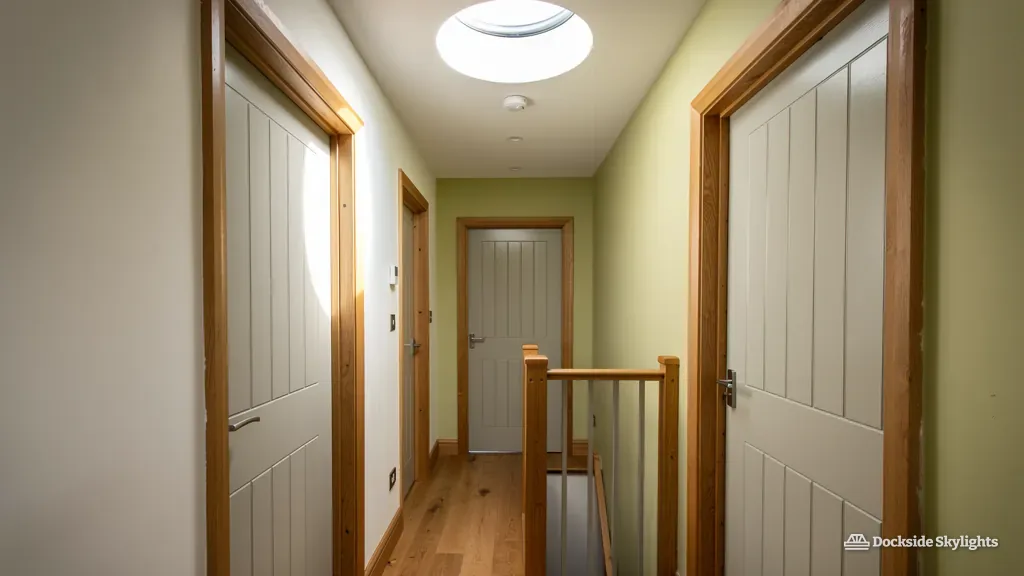
Utility rooms, walk-in wardrobes and the corridor to a rear extension follow the same rule. This chapter stops at the decision to use a tube. Routing from dome to ceiling deserves its own treatment, which it gets in sun tunnel routes, lengths and bends.
Rooms with a loft above
This is where the two products meet, and where the real decisions are made. A room with a loft above it has a ceiling, then joists, then loft space, then rafters, then the roof covering. That stack of layers is exactly what a sun tunnel passes through easily and a rooflight cannot.
A rooflight can serve a room with a loft above it only if the loft is part of the room. In a loft conversion the sloping ceiling is the roof, and the window sits in that slope. If the loft is a cold roof space with a hatch, a window cut into the roof would light the loft and nothing more. To light the room below, you would need a light shaft: a boxed-in lining from the roof opening to the ceiling, built from timber and plasterboard. It can be done, but it is proper carpentry that takes up space in the loft and trims joists.
A sun tunnel is the same idea made small. The tube is the light shaft. It is narrow, mirror-lined and light enough to hang between joists and rafters. Where a rooflight and its shaft would need timbers cut and framed, the tube threads between members that are already there.
If you are planning a loft conversion, the answer splits. The new bedroom wants roof windows, because they light the space, give a view and open for air. For the particulars, roof windows for loft conversions is the place to look. The landing beneath it, which loses its own light once the stair is boxed in, is a fine place for a tube. One house can take both, a window for the new room and a tube for the old landing.
- Is there a roof slope directly above the room?
- Is the loft boarded, converted or planned for conversion?
- Is there a stair, a tank or a run of pipework in the way?
- Do you want to see out, or just to see better?
- Does the room need air as well as light?
The roof work behind each choice
Each product begins by cutting an opening in the roof, and each depends on the seal around it. The size and shape of the hole is what differs.
A sun tunnel dome sits on a round or square base, flashed into the covering. On slate the base is lapped in so that water runs round it and over the slates below. On tile, the flashing is shaped to the profile, whether the roof is interlocking concrete or plain clay. The opening is small. In many roofs it falls between two rafters and no timber is cut. If a rafter is in the path, the survey is where we point it out and show you what would need to change.
A roof window needs a larger opening, trimmed with timber at the head and sill, and a flashing kit for the covering. If the window is wide, a rafter is cut and the load is carried by the trimmers. It is routine, but it is structural, and it matters most on older roofs where the rafters are hand-cut and the spacing wanders. Estates around St Helens and Warrington often have trussed roofs, and cutting any truss member there calls for a design from the truss maker or an engineer. A tube slips between the web members and avoids that conversation altogether.
The rules differ too. Building Control must be notified of notifiable jobs, which we do ourselves, because new rooflights and new roof windows alike are controlled work under the Building Regulations. The thermal limits for glazing in existing dwellings are set in Approved Document L, and our page on rooflight building regulations goes through them. On planning, rooflights are generally permitted development on a house within set projection and height limits, though flats, listed buildings and areas under an Article 4 direction are different, and our planning guide covers when permission is needed. At survey we tell you which route applies to the product you are choosing and what we notify.
Inside, a roof window needs a lined splay, plastered or boarded and painted. A sun tunnel needs a neat ring at the ceiling and insulation put back round the tube, which means less dust in a house you are living in.
North or south, grey day or bright
Orientation shapes how each product behaves, though less than people expect. A rooflight in a south-facing slope gets direct sun for much of the year, which brightens a room fast and also warms it. A blind or solar-control glass becomes sensible. A north-facing slope gives a steady, soft light with no glare.
Because a sun tunnel dome collects light from the entire sky and not just the sun, it depends far less on a south-facing slope. We keep the full account in a separate answer on sun tunnels on north-facing roofs.
On a grey day either product gives less light, and a larger glazed area gathers more of what there is. A tube gives a gentle, even light because the diffuser spreads what it receives, while a room with a rooflight shifts as clouds pass.
On a flat roof the sums change again. Either a tube or a flat-roof rooflight will go onto a flat roof. The upstand and covering detail for each is in the flat roof rooflights service page and the guide to a sun tunnel on a flat roof.
Making the choice, and when to have both
Put it as a short test. If you want a view or fresh air, and the roof slope is directly above the room, choose a rooflight. If the room is inside the house with a loft or other rooms over it, and you want daylight without a view, choose a sun tunnel. If the room is a converted loft, choose roof windows and give the landing below a tube.
Cost is the next question, and it depends on the route, the roof covering and the access, not only on the product. What drives the cost of a tube is set out in a separate answer on what sets the cost of a sun tunnel, and the costs page shows how every job is priced. With either product the order is the same: we survey, then hand you a fixed quote on paper, and when the work is finished you hold a ten-year workmanship guarantee in writing, described on the guarantee page.
The simplest way to start is to send us two photographs on WhatsApp: the room, and the roof from the street or garden. That is often enough to tell which product fits, and the survey confirms it.
Choosing between a tube and a window
Does a sun tunnel give as much light as a rooflight?
On a like-for-like basis a rooflight admits more, because the glazed area is larger and the light comes straight in. A sun tunnel gives a smaller, softer pool of light. Where a rooflight cannot be fitted at all, the tube gives you daylight you would not have had.
Can I add one to a room that already has a window?
Yes. A room whose window is small, or faces a wall, can take a tube to lift the whole space. The survey checks the roof above and the route down.
Which one is quieter when it rains?
Both can be heard in heavy rain. A tube has a small dome above the loft, so the sound reaches the room at one remove, while a large pane directly over the room is more exposed, and laminated glazing helps with that. We talk through the options at survey.
Can an old rooflight be swapped for a tube, or the other way round?
Either swap is possible. A tube means a smaller opening, so the old frame comes out and the roof covering is made good round the new base. Going the other way means a larger opening and trimming. We look at the loft and the rafters first, then quote.