What a like-for-like swap involves
Replacing an old VELUX window is the neatest of the roof window jobs, because the opening already exists. The frame, the flashing and the sash come out, a new window of the same size goes into the same opening, and the roof covering is dressed back around it. Done well, you lose a day of your attention and gain a window that opens smoothly, keeps the rain out and holds the heat in far better than the one it replaces.
That neatness is also where people go wrong. It is easy to assume that a new window is a new sash on the old frame, or that the old flashing will do, or that the lining indoors will simply carry on. Some of those things can be true and some cannot, and the difference lies in the details of your roof. This guide goes through the decisions in the order they arise: matching the size, dealing with the flashing, choosing the glazing and the way the window opens, and keeping the finished lining inside the room.
A word on names. Homeowners say skylight, and the trade says roof window or rooflight, and a VELUX is simply the best-known make of the type. The swap described here, one VELUX window for another, is the straightforward end of the work. Putting a window where there was none is a different job, set out on our VELUX window installation page, and a failed sealed unit alone is dealt with under misted rooflight replacement.
The only thing the swap really asks of you is a little information. If you can send us a photograph of the window open, with the label on the sash edge visible, and a picture of the room it lights, we can usually tell you whether yours is a clean like-for-like job before we visit.
Matching the size code
The first decision is the simplest. A new window has to match the old one's size code, because the opening in the roof, the rafters either side and the slates or tiles around it were all arranged for that frame. A window that is a step too wide cuts into a rafter. Go a step too small and the gap has to be made good with extra flashing and timber, and the result never looks as clean from the garden.
Width is given by the letters and height by the digits; VELUX window sizes and codes unpicks the rest. The point here is that the code on an old label may no longer be on sale in exactly that form. Models and finishes change, even where the frame size stays. We check the current equivalent against your opening at the survey, measure the opening itself instead of trusting the sticker, and tell you if the nearest current size would mean any alteration.
In most like-for-like jobs that conversation is over quickly. Where it is not, the usual reason is that someone, years ago, fitted a non-standard window or cut a rafter to suit it, and the opening is now a slightly odd shape. We find that on the survey, and it appears in the written quote, not on the day.
The flashing: why it is renewed
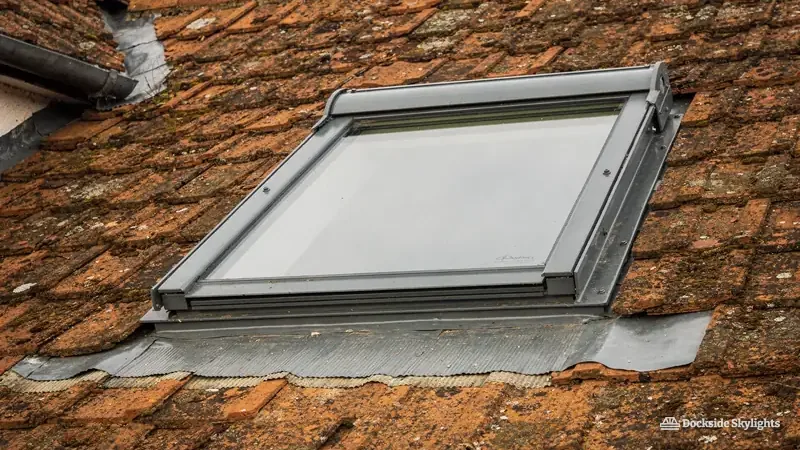
The flashing is the metal surround that carries water round the frame, and it is made for a particular frame. It is also the part of an old installation that has had the hardest life. Years of sun, frost, and rain driven in off the Irish Sea leave the metal stiff, dented, or pulled away at the corners, and an old kit is shaped to the old frame in ways a new frame does not quite follow.
So when we swap the window, the flashing is renewed with it, in a kit that matches the new frame and your roof covering. Kits differ for slate, for plain tile and for profiled or interlocking tile, and the right one is chosen at the survey. Reusing old flashing round a new window is the false economy of this job, because it sets a brand-new window into a surround that may be nearing the end of its life. The detail is explained in the guide to roof window flashing for slate and tile.
Renewing the flashing means lifting the slates or tiles round the opening and laying them back over the new kit, with any broken or slipped ones replaced to match. On a Victorian terrace with thin Welsh slate, those slates can be brittle, and it is worth knowing that a few extra slates may be needed. We allow for that when we survey. On a 1930s semi roofed in clay or concrete tiles, the tiles are sturdier, but the matching of the pattern matters, and we say so beforehand.
The underfelt round the opening is also looked at while the covering is back. A dry roof under the window depends on the felt being lapped correctly into the new kit, and if the old felt is torn or short, it is dealt with at this point instead of being left for a leak to reveal later.
Glazing and opening options now
A VELUX replacement window is a chance to improve on the old one, and glazing is where the biggest gap usually lies. Many windows put into roofs a generation ago had a sealed unit with no low-emissivity coating. Today's windows are double-glazed with a low-emissivity coating as standard, and further glazing choices exist. A laminated inner pane can make rain on the roof quieter, which is welcome in a loft bedroom.
Heat loss matters because the roof window is one of the thinnest parts of a house. The figure to hold a replacement roof window to in England is 1.4 W/m²K, or Window Energy Rating band B, as Table 4.2 in volume 1 of Approved Document L lays down for existing dwellings. That is the standard to hold the supplier to, and it is a much higher bar than a window from the 1980s ever met. The same rules make the swap controlled work, which we return to below.
The opening method is the other choice. The usual type, a pivot window, rotates about a bar across the middle of the sash, so the top swings out while the bottom swings in. A top-hung window opens from the top edge, which suits a view and a reach over a desk or a bed. Both are available as manual windows, and powered versions, electric or solar, can close themselves when it rains; which opening types come powered depends on the maker's current range. The full comparison lives in our page on pivot and top-hung opening, so it is not repeated here. If you are tempted by motor or solar, the electric opening rooflights page covers how they behave.
Swapping like for like does not mean swapping like for like in performance. The new window should be a good deal better than the one it replaces.
You can change the opening type in a swap, but not always without consequence. A pivot window and a top-hung window of the same code sit in the same opening, but they turn differently, so the clearance at the head and sill and the position of the handle change. The roof pitch, the room below and anything fixed beneath the window, like a shelf or a bed head, all decide whether the change suits you. We look at the room for that reason, not only the roof.
Keeping the inside lining
Indoors, the window is framed by a lining: the boxed splay of plasterboard or timber that finishes the opening between the sash and the ceiling. It is the part you see every day, and it is often freshly decorated. The good news is that a clean like-for-like swap usually keeps it. The old frame is taken out from above, the new one set in the same position, and the lining is left in place and made good where the new frame meets it.
It does not always go so smoothly. A new frame may be a few millimetres deeper or shallower than the old, and the inner edge of the frame may sit slightly differently against the lining. Where the gap is small, the junction is sealed and finished with trim. Where it is bigger, a new lining or a lining kit is fitted. It is better to hear that on the survey than to find it with the old window out and the sky showing.
The same goes for the insulation round the frame. A good installation packs insulation between the frame and the structure and seals the join to the underside of the felt, because that junction is where draughts and condensation start. If the old window was fitted without it, which happens, the swap is the chance to put it right.
- The lining stays when the new frame sits in the old position
- A shallow gap at the edge is sealed and trimmed
- A bigger difference means a new lining kit
- Blinds are checked against the new frame before ordering
- Decorated surfaces are protected throughout
Blinds need a thought of their own. Blinds are made to fit particular sizes of window, and the fittings that hold them on the frame can differ between older and newer models. Check what you have before you order the window, and tell us if you want to keep them.
Building Control, the day itself and what you get
Because swapping a roof window in England is controlled work under the Building Regulations 2010, Building Control must be told, whether that means the council's team or a registered building control approver. We handle that notification, and when the work is signed off, a completion certificate or final certificate is issued, depending on who inspected. File it with the house papers, as a buyer's solicitor may want to see it. Our guide to rooflight Building Regulations explains what sits behind it.
The day itself is brief. We cover the floor and furniture below the window with dust sheets, lift the covering round the opening, take out the old window and flashing, set the new frame and its kit, and dress the covering back over it. A single window is usually a matter of hours, and a run of several takes longer; the how long to fit a skylight answer has the pattern. Last come the checks that the sash opens and closes cleanly, the clearing up, and the room handed back as we found it.
Two documents come out of the job: a fixed quote in writing, settled once the survey was done and not earlier, and the written guarantee on the workmanship, valid for ten years. Thinking of replacing a window? Get a free quote, or begin with a WhatsApp photo of the label and of the room.
Before you book the swap
Can I reuse my old blinds on the new window?
Sometimes. Blinds are made for a given window size and for a given fixing, so a blind from the same code may fit, but newer frames can use different brackets. Tell us which blinds you have, and we will check them against the replacement before the window is ordered.
Will the new window look different from outside?
Slightly, yes. Frame colour and flashing finish have changed over the years, and a new kit stands a little differently on the roof. In most cases the change is a tidier edge and a cleaner line on the slope, not a different size or shape.
Must someone stay in the house during the swap?
It helps to be there at the start to agree access to the room, and again at the end to check the finished window. In between, the work happens on the roof and at the opening, so you can carry on with the rest of the house.
Is it worth replacing a window that still opens?
That depends on what is wrong with it. If the glazing is single or thin, the frame is soft, the flashing has lifted or the room is cold and noisy, a new window brings real benefits. If it is sound and only the glass has clouded, replacing the sealed unit alone may be the better route, which we explain under misted rooflight replacement.