The choice of flat rooflight vs roof lantern comes up on almost every rear extension we survey. The extension has a flat roof, the kitchen is deep and dim at the back, and the family wants daylight where the old rear wall used to be. Two products can supply it. One is a sheet of glass set into the roof. The other is a glazed structure that rises above it. They both let light in, but they look different, behave differently overhead and make different demands on the roof beneath them.
Two products that share a roof
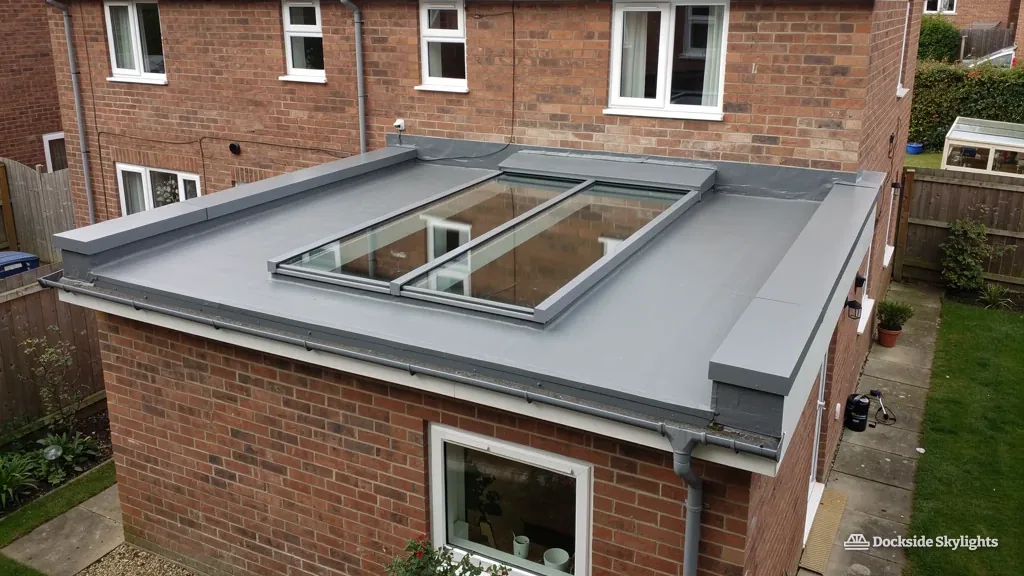
A flat rooflight, or flat glass skylight, is a sealed glazed unit in a frame, fixed to an upstand that lifts it clear of the roof. The glass sits almost level, with just enough slope to let rain run off. A roof lantern is a raised, multi-sided glazed roof: a frame of bars in aluminium or uPVC, with panes of glass angled up to a ridge or a central point. The ridge may run the length of the lantern or, on a hipped version, meet in a point.
Both belong to the same trade family. As far as the Building Regulations are concerned, a roof lantern and a flat pane are both rooflights. Either one, when new, is notified to building control, and both face the same energy limit for existing dwellings. What differs is everything you can see and feel: how the light falls, how the ceiling looks, what the roof needs, and what each costs to make and to fit.
Picking a flat glass skylight or lantern is easier with a few facts about your own room in hand. Roof size, ceiling height, the outlook on the garden side and the direction the extension faces will each tilt the answer. The sections below take them one at a time.
How the light arrives
Flat glass delivers light from directly above. In a room with a single flat rooflight the brightest patch sits under the glass and fades towards the walls, and the angle of the sun matters. High summer sun comes straight through. Low winter sun, particularly at the far end of the day, passes over the glass at a shallow angle and gives much less. Fitting several rooflights spreads the light further, which is why a long galley kitchen often does better with two or three smaller panes than one big one.
A lantern gathers light on several faces at once. Glass angled in different directions catches the sky from more of its dome, and because the faces lean in towards the middle, the light also reaches sideways into the room instead of dropping like a lamp. On a dull Liverpool day, when the sky is a bright grey blanket, that wider catchment helps the room feel evenly lit. The effect is gentle rather than dramatic. A lantern is not a magic source of brightness, and a badly placed one will still leave the corners dim.
Both products control heat and glare the same way: through the glass. Solar control coatings reduce summer heat gain on a south or west-facing roof, and low-emissivity coatings with a warm edge spacer keep winter heat in. A lantern has more glazed area for the same footprint, so the choice of glass counts for more with a lantern, and a west-facing one needs an honest conversation about blinds or tint before it is ordered.
Sizing a lantern to the room is its own subject, covered in Roof Lantern Sizes: Matching the Lantern to the Room. For flat glass, the question is mostly how many panes and where they sit.
What you see from inside
A flat rooflight sits in the ceiling plane. From below it reads as a clean opening, a rectangle of sky in a plain ceiling. It suits a modern kitchen with a simple, flat ceiling, a hallway that needs borrowed light, or a utility room where the light matters more than the look. There is no architectural feature to dress. A good flat rooflight in a plain ceiling nearly disappears into the room.
A lantern is a feature. It adds height and a sense of volume, because the eye follows the glass up to the ridge instead of stopping at the ceiling. In a kitchen-diner, a lantern above the table gives that part of the room its own centre. The bars, the internal lining and the way the ceiling meets the light well all show, so the finish counts. It rewards the detail: painted plaster reveals, a neat junction, a lantern frame colour that works with the kitchen units and the window frames.
Ceiling height is a practical limit. A lantern needs room above it, and the ceiling below has to be high enough that a raised glass roof does not feel like it is pressing down. Low extension ceilings suit flat glass better. A lantern also needs a taller lining than a flat unit, so the plasterwork around it is a larger job.
Flat glass lets light into a room; a lantern gives the room a new ceiling to look up at.
What you see from outside
From the garden, a flat rooflight is barely a feature at all. Glass on a low upstand sits close to the roof, and on a dark single-ply roof it looks like a few dark rectangles. That is a virtue on a terrace where neighbours overlook the extension from upstairs windows, or on a conservation-led street where nobody wants the roof to draw the eye.
A lantern changes the silhouette. On a wide extension behind a Victorian terrace, or a bungalow with a long rear elevation, a well-proportioned lantern can look like the extension was always meant to have one. On a short extension, or one tucked in between neighbours' walls, it may stand tall for its setting. Compare the height it stands above the roof with the planning rules before you order; the planning permission for a skylight guide sets them out.
Seen from upstairs windows next door, the two also read differently. Looking down on a lantern shows a ridge and bars. Looking down on flat glass shows the sky reflected or the room beneath. Neither is a problem, but if a view onto the roof matters to you or a neighbour, it is worth knowing which you are choosing.
Cleaning, condensation and upkeep
Flat glass on a low slope collects what lands on it: leaf mould, bird droppings, pollen. With a shallow fall, rain does not wash it clean as well as it would a steeper pane, and a film of dirt builds up. It is reachable, though. On a single-storey extension you can usually clean flat glass from a ladder at the eaves or with a long pole.
A lantern has a steeper face, so rain does more of the cleaning, and self-cleaning glass coatings do their best work on that angle. But there are more panes, more bars and more edges where dirt gathers, and the ridge is out of reach for a normal window cleaner without access equipment. Over a kitchen extension that backs onto a trees-and-wall garden, the reality is a periodic wash of the roof glass and a wipe of the internal bars.
Condensation depends on the frame and glass specification more than the shape. A warm-edge double or triple glazed unit with an insulated frame resists it. A cheap frame with a metal spacer does not. In a steamy kitchen, a vent that opens, or a trickle vent built into a lantern frame, lets moisture escape. What neither shape should do is leak, and that comes down to the upstand and the flashing, not the glass. For the upstand that carries either shape, read flat roof rooflight upstands.
What drives the cost
Price is never the first thing to decide, and neither product has a standard price until someone has looked at the roof. The drivers are the same ones each time, though, and knowing them helps you compare quotes properly.
For flat glass, the main cost drivers are the size and number of panes, the glass specification, whether the unit opens, and the kerb. A fixed pane on a simple kerb is the lighter end. An electric opening unit with a rain sensor and a larger insulated kerb is further up the scale. Flat rooflights are usually available quickly in standard sizes.
A lantern's cost is shaped by the frame material, the number of bars, the glass and any made-to-measure fabrication. It usually takes longer to make than a standard flat rooflight, so lead times differ. It also asks more of the roof and the room around it: a bigger structural opening, a heavier unit and more internal finishing. Aluminium and uPVC frames are different again, and the choice is weighed up in Aluminium or uPVC Roof Lantern: Choosing the Frame. Costs have their own answers, one on flat roof skylight cost and one on roof lantern cost.
| Question | Flat rooflight | Roof lantern |
|---|---|---|
| Light | Straight down from above | From several angled faces |
| Ceiling height needed | Works under a low ceiling | Needs more height below |
| Look from the garden | Low, quiet | A visible roof feature |
| Cleaning | Reachable, shows dirt | Rain helps, more edges |
| Cost drivers | Panes, glass, opening, kerb | Frame, bars, glass, structure |
Choosing for your extension
Put the questions in order. Start with the ceiling: if it is low, the choice is usually already made. Then the room. A long, narrow room with a single dim end tends to want two or three flat panes. A wide kitchen-diner with a table that needs a focal point suits a lantern. Last comes the roof underneath. A lantern puts more demand on the joists and the opening, and putting a lantern on an existing flat roof gets a separate write-up.
- Finished ceiling height in the extension
- Which way the roof faces
- How high the roof will appear from the garden and from the neighbours’ side
- Whether the room needs one focal point or an even spread of light
- Who will reach the glass to clean it
Plenty of extensions use both: a lantern over the dining end and a flat rooflight over the utility room or hall behind it. The two products are not rivals so much as tools for different parts of the house. Our surveyor looks at the actual roof, the actual ceiling and the actual garden, then gives you a straight recommendation and a fixed written quote. Building Control notification, where the job needs it, is something we send, and on completion you hold our workmanship guarantee in writing for 10 years. Our flat roof rooflight installation page shows the wider range, or ask for a free quote and we will come out to look.
Still deciding between glass and lantern
Can I have both on the same extension?
Yes, and it is common. A lantern over the dining area with flat glass over a utility room or a hallway makes sense when the light needs differ across the plan.
Is a lantern always brighter than flat glass?
Not automatically. A lantern has more glazed area and catches light from more directions, but a small lantern over a large room can be dimmer than three well-spaced flat rooflights. Placement and total glass area do most of the work.
Which one is easier to keep dry?
Neither is, by nature. Both depend on the upstand and the way the roof covering is joined to it. A lantern has more joints in its frame, while flat glass is a simpler form, but a good kerb and flashing matter equally for both.
Can I swap flat glass for a lantern later?
Usually you can, but the opening and the joists were sized for the first unit. A lantern is heavier and needs a bigger opening, so allow for the structure to be checked and altered as part of the work.