Skylights or rooflights for estuary-side bungalows and cottages near Longton
Longton is a Lancashire village beside the Ribble estuary, with older brick cottages along its main roads and bungalows, semis and new estates spreading behind them. Skylight installation here is often about bungalow lofts and rear extensions, and rooflight installation in Longton means allowing for wind that comes off the marsh.
29.1 road miles north of Liverpool city centre
What leaves a Longton bungalow or semi short of daylight?
- The dormer bungalow loftAbove the ground floor of a Longton bungalow, a loft space has the height for a bedroom but no gable or dormer window, so the slope itself must carry the light.
- The extended kitchen dinerAt the back of a brick semi near the village centre, a kitchen and dining space was joined into one deep room, and the centre of it sits far from any wall window.
- The estate house landingOn a landing in a newer estate house off the main road, the stairs and bathroom share a windowless core, and the upstairs hall depends on borrowed light.
Dormer lofts, kitchen diners and estate landings
Choosing skylight installation in Longton means matching the service to the roof: a handful of village cottages, brick semis, a very large number of bungalows and newer estates each want something different on offer here.
- Lanterns over kitchen and garden-room extensions on the bigger plots, the glass sized to whatever span the roof structure can carry.
- Flat rooflights over the rear extensions bolted onto brick semis, raised on a kerb so rainwater cannot pool around the frame.
- Roof windows for bungalow lofts and tiled semis, placed in the slope so a bedroom upstairs has headroom beneath the opening.
- Opening rooflights for hot rear extensions where a fixed pane traps heat, controlled by a switch or a remote.
Brick cottages, bungalows and the estates behind the main road
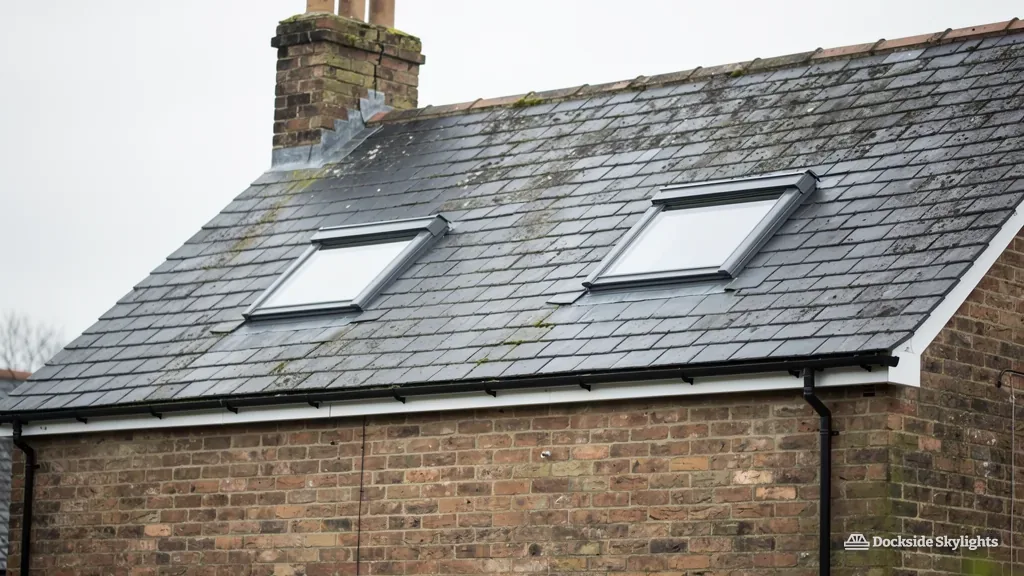
The old brickworks site, now the Longton Brickcroft nature reserve, recalls the local clay, and brick is the material of the older buildings on the village's main roads. The cottages and small houses of the old settlement are brick, many of them under slate or older clay tile, set close to the road with gardens behind. They are modest in size and their roofs are low, and the rooms underneath tend to be small. Rooflights here are chosen carefully, because a large unit would dominate a small slope, and a pair of smaller ones often looks better than one wide window. The glazing is kept plain so that it does not draw the eye from the street.
The bulk of the housing is more recent. Semis and bungalows lined the roads into the village between the wars and after them, and the fields behind were then filled, decade by decade, with concrete-tiled detached and semi-detached estates. Bungalows are a signature of the area. A bungalow roof is a large single plane with a loft above, and many have been converted or are waiting for it. Almost every other house has a single-storey rear extension under a flat or shallow roof, and in many of them the knocked-through back wall has left the old middle of the house in the dark. A rooflight over that middle is often the simplest way to light it.
For rooflights, this means the work divides into a few families of job. A bungalow loft wants roof windows, ideally in pairs or on a long slope with the cill at a sensible height. A rear extension wants either a flat light or a lantern. A newer house on an estate, with an enclosed stair, wants a sun tunnel or a small roof window above the landing. And an older cottage wants a unit that sits low, in proportion to its small roof.
The village is mostly bungalows, semis and extensions, and nearly every one of them can take some form of rooflight.
Outside the village proper, the land around Longton is flat and open, with the marsh to the west and farmland to the south and east. Houses on its edges tend to be larger, with big gardens, and are sometimes extended in more than one phase, which leaves different roof types joined together on one building. Each section therefore gets its own look at the survey, since covering, pitch and age can change from one part of the building to the next. A 1960s bungalow with a 1990s side extension and a recent rear kitchen can carry three different roof coverings, and each one wants its own flashing kit and its own way of making a watertight joint with the unit.
Open ground by the estuary and what it means for a fixing
Longton lies close to the Ribble estuary, and to its west the marsh and mudflats are flat and treeless. Nothing slows the wind as it crosses that open ground. In practice that means a skylight on a west-facing slope is working harder than one in a built-up suburb, and the fixings, flashing and sealing details are chosen to cope with it. For a bungalow roof, which has a large unbroken surface and little shelter, the pressure on any opening is higher than the same unit would feel in a terrace.
Salt in the air is part of this too, drifting inland on the stronger winds. Exposed metal near the coast ages faster, so flashings and fixings are specified in materials that suit the setting, and any bare edge is sealed. This is a feature of where the village sits and not a reason to avoid a rooflight; it simply shapes the specification.
The loft of a bungalow needs particular attention. The roof is often a cut roof with purlins and struts, and the structure decides where an opening can go. A roof window that lands on a strut or a purlin has to be moved or the timber reworked by a competent person. A rear extension with a flat roof raises a different question, which is the fall: water needs to run off the surface towards a gutter, and a kerb that stands in a pond of water is a poor foundation for a rooflight.
Access is easier than in a town centre. Most roads are wide, houses are set back, and there is usually space for a ladder, a tower or a small platform. A single-storey bungalow roof can often be reached from a low ladder, so fitting goes quicker there. Lantern glass on the bigger extensions is heavy, needing two people or a small crane to lift, and the route for that is planned before the day. On a bungalow with a long rear garden, materials can be carried round the side or passed over a low wall, and the skip or waste bags are placed where they will not block the drive. Little of this is difficult, but all of it is better arranged beforehand than discovered when the van arrives.
Weather also arrives from the estuary side in short, hard bursts, so we avoid fitting on a day when a gust could lift a loose slate or a part-sealed flashing, and a roof is never left open overnight.
- Walk the roof. The covering, the pitch and the direction the wind will hit from are all checked.
- Find the structure. The loft shows where the rafters, purlins and struts sit.
- Choose the unit. Size, glazing and opening style are matched to the room and the slope.
- Order the flashing. The kit is picked for the covering, tile or slate or felt.
- Fit and seal. The unit goes in, the edges are lapped and the room is left tidy.
South Ribble Borough Council and the sign-off for a rooflight
Longton is in the borough of South Ribble, and the planning authority is South Ribble Borough Council. Most householder work comes through its planning service, and listed buildings and any protected areas are dealt with there too. Whether a particular property is listed or sits under a direction can be confirmed on southribble.gov.uk. Longton is a village, and most of its houses are ordinary homes with no special status, but the check takes minutes and is worth making. It also tells you early whether a local direction exists on your road, which saves a surprise later on.
For those ordinary houses, a rooflight is generally permitted development. How far a unit may project, how high it can sit and what applies to a side slope are all covered in the permitted development limits for skylights. If your house is a bungalow whose loft is being converted, the loft conversion guide at roof windows for loft conversions covers what the conversion involves.
Before work starts on a Longton rooflight, we tell South Ribble Council's building control, and the standard each unit must meet has its own guide.
A bungalow loft raises one question the other roofs do not, which is the way out in a fire. A single-storey house can use a roof window as the way out of a loft room, but only if the openable area reaches 0.33 square metres, the opening measures 450mm or more each way, and the bottom edge sits no higher than 1100mm off the floor. Those figures come from Approved Document B, volume 1, and how the escape rule works in practice is worked through separately. A two-storey house is different, and a roof window there cannot serve as the exit.
Before the survey, it helps to have a few things to hand, so nothing needs to be chased later.
- Any earlier building control certificate for a loft or extension
- The age of the roof covering, if you know it
- Whether the house is listed or has a local direction
- Where you would like the light, drawn on a photo if easier
Straight answers for Longton bungalows and semis
Can my Longton bungalow loft be fitted with roof windows that count as an escape?
A roof window in a single-storey Longton bungalow can serve as the escape from a loft room when it meets the size and height rules in Approved Document B, volume 1. We check the opening size and the cill height against those rules at the survey and confirm what fits.
I have a brick semi with a flat-roofed kitchen extension. Is a lantern realistic?
A lantern suits a brick semi with a flat-roofed kitchen behind it, as long as the extension roof can carry the weight, and that turns on the joists and the span. We open up the structure at the survey, measure the opening, and say whether a lantern or a flat rooflight is the better choice before a quote is written.
Which parts of Longton and the villages nearby do you cover?
Longton and the villages around it are covered, including Hutton, Walmer Bridge and Much Hoole on the roads either side of the village. Survey and fitting visits in the area are grouped by village where we can, so a neighbour's booking sometimes brings yours forward.
Does the wind off the Ribble marsh affect which rooflight I should buy?
It affects how the unit is fixed and flashed more than which unit you choose. Open ground means a west-facing slope takes more wind-driven rain, so we specify the laps, fixings and sealing for exposure and tell you what we recommend.
Can a rooflight cure the dark middle left when a Longton kitchen was knocked through?
A deep kitchen-diner made by knocking through the back wall of a Longton semi loses its old window light in the centre of the room. A flat rooflight or small lantern over that spot restores it from above, and the survey works out how far the glass can reach before a second unit is worth adding.
Penwortham north-east, Tarleton and Hesketh Bank
Penwortham lies to the north-east, while Tarleton and Hesketh Bank, out on the flat country to the south-west, each carry a page of their own.
Free survey
Get a fixed quote in Longton
- No obligation
- We survey the roof before we price
- WhatsApp or phone, whichever suits
What happens next: we arrange a survey at a time that suits you, measure the roof and the room, then send a fixed written quote. Nothing is booked until you say yes.